
Learning how to measure for replacement windows starts with more than one width and height. Each opening can be slightly different because homes settle, frames shift, and previous work may have changed the trim or jambs. Measure the opening at several points, record the smallest clear dimensions, check the depth and condition, and have the measurements verified before ordering a new window.
Contact Referred Restoration online or call (763) 726-4245 to discuss a window measurement and inspection.
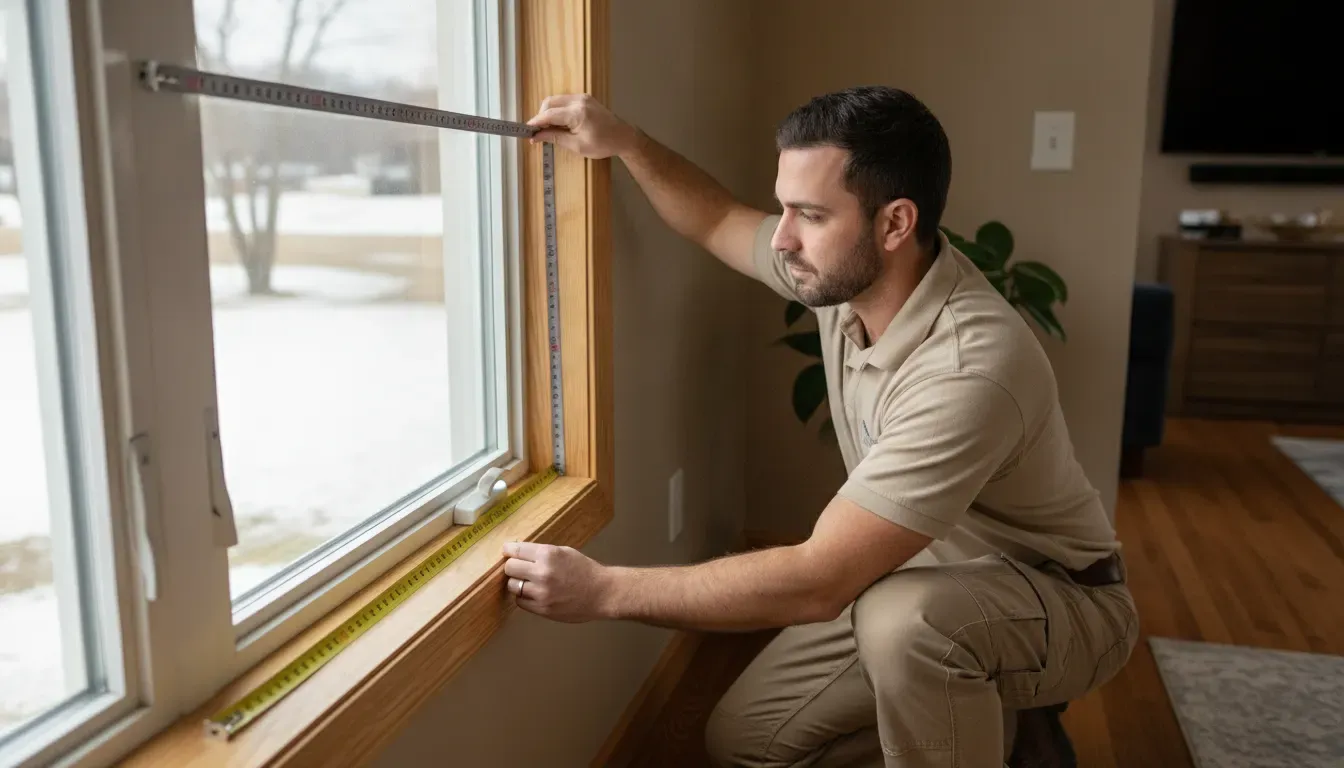
A careful measurement gives an installer useful information, but it does not replace an assessment of the existing window system. The correct replacement method depends on whether the existing frame stays in place, whether the opening has moisture damage, and how the new unit will connect to the home’s weather barrier. Once the opening is understood, compare frame, glass, and operating-style considerations in this Minnesota house-windows selection guide.
Short answer: Measure the clear width at the top, middle, and bottom of the opening. Measure the clear height at the left, center, and right. Record the smallest width and smallest height, then measure the jamb depth and compare the two diagonal measurements to check whether the opening is square. Repeat this process for every window. Do not order from one rough measurement alone.
What Tools Do You Need to Measure a Window?
Use simple tools that make repeatable measurements easier:
- A rigid metal tape measure that shows small increments clearly
- A pencil and a worksheet, notebook, or phone note for each opening
- A small level to check whether the sill and head are reasonably level
- A straightedge or framing square when the opening is accessible
- A flashlight for looking into the jamb, sill, and corners
- A helper when a window is wide, tall, or difficult to reach safely
Do not lean out of an upper-story window or climb onto a roof to take an exterior measurement. Record what can be measured safely from inside, then tell the installer which dimensions still need to be confirmed. Safety matters more than completing a worksheet.
How Do You Measure the Width of a Replacement Window?
Measure the clear opening from side to side, not just the visible glass or the outside edge of the decorative trim. The exact reference points depend on the replacement method, so note whether you measured between the existing jambs, the frame, or a rough opening that has been exposed.
Take three width measurements
- Place the tape across the opening near the top.
- Measure across the middle.
- Measure across the bottom, close to the sill.
Write down all three numbers. Compare them and use the smallest clear width as the cautious planning dimension. A smaller measurement can reveal a bowed jamb or an opening that narrows in one area. Do not average the three numbers and assume the window will fit. The installer may need to identify why the opening changes before selecting a unit or deciding whether the frame needs preparation.
If interior trim blocks the jamb, do not guess where the framing ends. Note that the trim remains in place and ask whether it should be removed for a final measurement. A pocket or insert replacement may use the existing frame, while a full-frame replacement may require a different set of dimensions after the old unit and trim are removed.
How Do You Measure the Height of a Replacement Window?
Height measurements show whether the opening is consistent from one side to the other. Measure from the same bottom reference point each time, such as the top of the sill or the bottom of the clear opening, and use the same top reference point for every reading.
Take three height measurements
- Measure on the left side of the opening.
- Measure through the center.
- Measure on the right side.
Record the three readings and identify the smallest clear height. Do not measure only the movable sash, the screen, or the finished glass. Those parts describe the existing window, not necessarily the space available for a replacement unit. If the sill slopes or the top of the opening is uneven, record that condition in your notes instead of hiding it in a rounded number.
Repeat the height measurement after checking that the tape is straight and fully extended. A tape that bows, catches on a seal, or starts from a different point can make two readings look more consistent than they are. Small differences can affect shimming, leveling, and the way the sash operates after installation.
How Do You Measure Window Depth?
Depth describes the space from the exterior side of the existing frame or opening to the interior edge of the jamb. It helps determine whether a replacement unit can sit within the existing frame and whether the available space can accommodate the window, insulation, trim, and sealing materials.
Measure the depth at more than one location when the opening is accessible. Check the top, side, and sill areas, and record any location where the depth changes. Include notes about interior extensions, old storm-window tracks, drywall returns, exterior casings, or other parts that may limit the replacement.
There is no single universal depth deduction that fits every window style or installation method. Do not subtract a generic amount and treat the result as an order size. A manufacturer may specify different clearances, and an installer may recommend a pocket, full-frame, or another approach after examining the opening. Your depth notes help that decision, but professional verification should control the final unit specification.
How Can You Tell Whether a Window Opening Is Square?
Uneven openings are common in older homes and in openings that have experienced moisture or structural movement. Width and height alone may not show the problem. Compare the two diagonal measurements by measuring from the upper-left corner to the lower-right corner, then from the upper-right corner to the lower-left corner.
If the diagonal measurements are close, the opening is more likely to be square. If they differ noticeably, record both numbers and do not force a replacement window into the opening. A professional can determine whether the difference is within the installation tolerance for the selected unit or whether the opening needs correction first.
Also look for:
- A sill that slopes, flexes, or feels soft under light pressure
- Gaps, cracks, or daylight around the frame
- Water staining, peeling finishes, or recurring dampness
- Rot, swelling, or deteriorated wood near the sill and corners
- Cracked masonry, damaged siding, or failed exterior sealant
- A sash that binds even when the opening appears straight
These observations are part of the measurement record. A window can have accurate dimensions and still need a different repair or preparation plan because the surrounding opening is not sound. If the frame is sound but the issue appears limited to hardware, seals, or a localized opening problem, review the window repair and replacement service options in Rogers before choosing a full replacement.
Should You Measure a Window from the Inside or Outside?
For many homeowners, the safest starting point is the interior opening. It provides useful width, height, jamb-depth, and condition information without requiring a ladder or roof access. Exterior measurements can add context, especially when brick, siding, exterior casing, or a storm window affects the opening, but they should not replace an interior inspection or professional field measurement.
The correct reference points also depend on the type of replacement:
- Insert or pocket replacement: The existing frame usually remains in place, so the clear space inside that frame is important.
- Full-frame replacement: The existing window and more of the surrounding assembly may be removed, so the final opening can be different from the visible interior dimension.
- Basement replacement: The installer may need to consider the window well, emergency escape requirements, and the condition of the masonry or framing.
- Bay, bow, or specialty window: Several connected openings and supporting details make a professional field check especially important.
When the installation method has not been decided, label your notes as preliminary. That prevents a rough interior measurement from being mistaken for a final order size.
Contact Referred Restoration online to have the opening condition and replacement approach reviewed before you order.
How Should You Record Window Measurements?
Give every opening its own label, such as living room south, bedroom 2, or kitchen above sink. A simple record makes it easier to compare measurements and prevents one window’s dimensions from being applied to another.
| Record | What to write down | Why it matters |
|---|---|---|
| Width | Top, middle, and bottom readings, plus the smallest width | Shows whether the opening narrows or bows |
| Height | Left, center, and right readings, plus the smallest height | Shows whether the sill or head is uneven |
| Depth | Jamb depth at more than one point | Helps identify fit and trim limitations |
| Diagonals | Upper-left to lower-right and upper-right to lower-left | Helps reveal an opening that is out of square |
| Condition | Moisture, rot, cracks, soft wood, failed sealant, or damaged siding | Signals preparation or repair needs |
| Operation | Sticking, failed locks, fogged glass, or sash movement | Connects the measurement to the window problem |
Photographs can help too, especially when they show the full opening, the sill, the exterior transition, and any visible damage. Keep the opening label in the photo filename or note, but do not rely on a photo to establish a dimension. The tape measure and written record remain the primary evidence.
Why Does Every Window Need Its Own Measurement?
Windows in the same room can have different dimensions, and windows on different sides of a home can have different exposure and weathering. An addition may have been framed separately from the original house. One opening may have been repaired, while another still has its original trim. Even paired windows can differ enough to require separate specifications.
Measure each opening rather than measuring one and copying the result. This is particularly important when the home is older, the exterior has been remodeled, or several window styles are present. A complete record also helps an installer group similar openings without assuming that they are identical.
What Minnesota Conditions Should You Consider?
Minnesota windows need to manage cold winters, wind, snow, rain, and freeze-thaw movement. Measurement and installation are connected because the new unit must fit the opening while allowing the installer to create a durable transition to the wall and exterior drainage layers.
During an inspection, ask how the plan addresses:
- Air sealing around the frame to limit drafts
- Flashing and sill protection to direct water away from the opening
- Insulation that fills the gap without distorting the frame
- Exterior sealant and trim transitions exposed to precipitation
- Interior finish details that prevent drafts and moisture from reaching the wall
- Safe work conditions when snow, ice, or low temperatures affect access
The U.S. Department of Energy and ENERGY STAR both emphasize that window performance depends on the complete product and its installation, not only on the glass package. Review the ENERGY STAR guidance for buying and installing replacement windows as you prepare questions for an installer.
For local homeowners, the surrounding opening deserves the same attention as the replacement unit. Water staining near a sill, damaged siding, or a gap around the exterior casing can affect how the installation should be prepared. Identifying those conditions before ordering helps avoid surprises on installation day.
When Should a Professional Verify the Measurements?
Professional verification is especially important before ordering when the opening is out of square, the frame is soft or damaged, the depth changes, or the replacement method is not clear. It is also wise to schedule an assessment for upper-story windows, basement openings, bay or bow windows, and homes with recurring water intrusion.
A professional can compare your notes with the existing assembly, inspect the condition behind the trim, and determine whether a repair, insert, or full-frame replacement is appropriate. That review also creates an opportunity to discuss the installation sequence, weather protection, and final operation before materials are selected. For a step-by-step overview of the next stage, see what residential window installation involves.
If your measurements disagree, do not choose the smallest number from one reading and place the order. Recheck the opening, preserve all of the readings, and ask an installer to resolve the difference. The goal is not simply to find a number. It is to understand the opening well enough for the new window and its seals to perform together.
Contact Referred Restoration online or call (763) 726-4245 for a professional window assessment in Rogers, Cottage Grove, and nearby Minnesota communities.
Frequently Asked Questions
How many times should I measure a replacement window opening?
Measure the width at the top, middle, and bottom, and measure the height on the left, center, and right. Repeat any reading that seems inconsistent and keep every number in your record. The smallest clear width and height are useful planning dimensions, but an installer should verify the final specification.
Do I measure the old window or the opening?
Measure the opening or the existing frame, depending on the replacement method. The visible glass, sash, and screen do not necessarily describe the space available for the new unit. A professional can identify the correct reference points after determining whether the project uses an insert or full-frame approach.
What is the rough opening?
The rough opening is the structural space prepared for a window before the complete window assembly, trim, and finish details are installed. It may not be visible when an existing window and interior trim remain in place. Do not assume that the visible opening is the rough opening.
Should I subtract a fixed amount from my measurements?
Do not use a generic subtraction as a final order rule. Required clearance depends on the window product, installation method, opening condition, and the manufacturer’s instructions. Give the full set of measurements and condition notes to the installer so the correct allowance can be determined.
Can I use one measurement for every window in my home?
No. Measure each opening separately. Homes settle, additions may be framed differently, and previous repairs can change the dimensions or condition of individual openings. Even matching windows can have different clearances.
Does window depth really matter?
Yes. Depth helps show whether the selected window can fit within the existing frame and whether there is room for insulation, trim, and sealing details. A depth that changes around the opening should be documented and reviewed before the replacement is selected.
Contact Referred Restoration online or call (763) 726-4245 to plan your replacement-window measurement and installation review.