
Metal roofing sheds rain and melting snow quickly, which makes the gutter system more than a finishing detail in Rogers, Cottage Grove, and communities along the Monticello corridor. That runoff must be directed away from siding, walkways, and the foundation before Minnesota’s freeze-thaw cycles create larger problems.
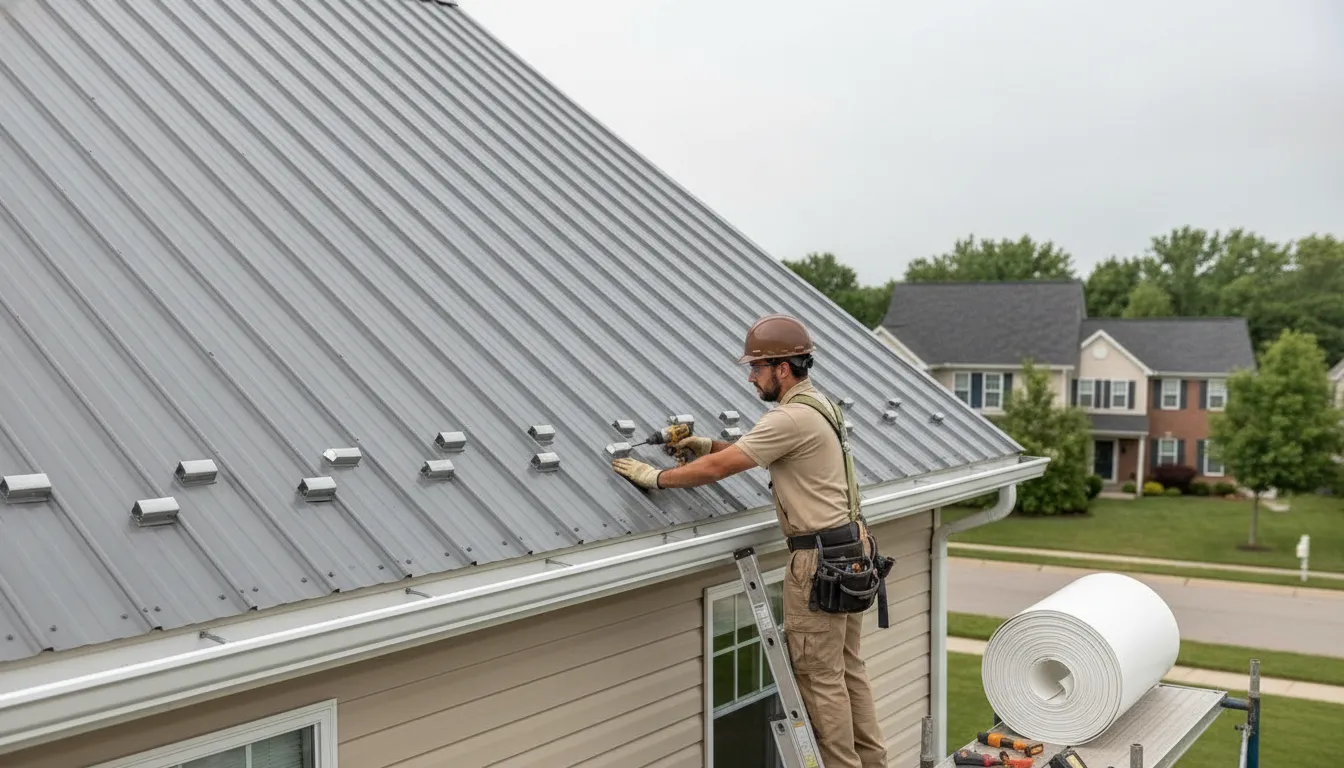
For Minnesota homes, seamless gutters for metal roof systems should be sized for the roof area. Matched to the panel layout, and secured with attachment methods that account for metal expansion and contraction. The right combination helps control fast runoff while reducing joints where snowmelt can expose weak points.
Contact Referred Restoration online
The best design starts by looking at how a metal roof moves water and where that water goes next. That connection between roof shape, gutter capacity, and winter conditions explains why choosing the right gutters matters.
Why Metal Roofs Need the Right Gutters
Metal roofing is designed to move water and snowmelt off the roof efficiently. That is an advantage during Minnesota storms, but it also means the gutter system must be ready to receive and control a fast-moving volume of runoff. When the gutter is too small, poorly pitched, or not positioned correctly. Water can overshoot the channel, pool at the roof edge, or discharge too close to the house.
The goal is not simply to attach a gutter beneath the roof. It is to create a continuous path from the metal panels to the gutter, through the downspouts, and safely away from the home.
Fast runoff needs enough capture capacity
Metal roofs can shed rain and melting snow quickly, especially when the roof has a steep pitch or a large uninterrupted surface. A narrow gutter may fill faster than it can drain. While a gutter installed too far below the eave may allow water to leap over the front edge during a heavy downpour. The result can look like a roof problem even when the underlying issue is drainage capacity or placement.
Seamless gutters for metal roof installations should be evaluated with the roof area, pitch, valleys, and downspout locations in mind. The correct approach may include larger channels, additional downspouts, or carefully planned outlet locations rather than treating every roof edge the same.
Controlled discharge protects siding and the foundation
A gutter system protects more than the roofline. Without controlled collection, runoff can streak or saturate siding, splash onto windows, erode soil, and collect beside the foundation. Repeated moisture at the foundation can contribute to settlement concerns, basement seepage, or damage to nearby landscaping. Downspouts should direct water away from the house and discharge where the surrounding grade can carry it away.
Correct pitch matters just as much as channel size. Gutters that sag or slope away from their outlets hold water and debris instead of moving runoff to the downspouts. In winter, that standing water can freeze and add weight to the system. A properly aligned installation keeps the drainage path open through both summer rain and spring thaw.
Minnesota winter conditions add another concern
Snowmelt and freezing temperatures can expose weak points in a roof drainage system. The University of Minnesota Extension explains that ice dams form when snow melts on warmer portions of a roof. Then refreezes at a colder roof edge and backs water up. That process is driven primarily by uneven roof temperatures and heat moving from the home toward the roof, so gutters alone cannot prevent every ice dam. However, a sound gutter system helps manage water at the edge and reduces avoidable overflow against the exterior.
Choosing the right drainage plan starts with understanding the roof’s specific runoff pattern. Homeowners comparing materials can also review the metal roof drainage needs of different roofing systems before finalizing the gutter layout.
Seamless vs Sectional Gutters for Metal Roofs
Metal roofing can shed rain and snowmelt quickly, so the gutter system must handle concentrated runoff without creating weak points along the roofline. The key difference between seamless and sectional gutters is the number of joints. Seamless gutters are formed in one continuous run for each side of the home, while sectional gutters are assembled from shorter pieces joined together.
Fewer joints generally mean fewer locations where sealant can fail, fasteners can loosen, or movement can open a gap. That matters during Minnesota snowmelt, when water may move through the system repeatedly as temperatures rise and fall. Seamless gutters are not maintenance-free, and they can still leak if the slope, hangers, outlets, or downspouts are poorly designed. However, reducing the number of seams removes one common source of trouble. For more context on durable seamless drainage systems, consider how material choice and continuous construction work together.
| Consideration | Seamless gutters | Sectional gutters |
|---|---|---|
| Joint count | Few joints, usually limited to corners, outlets, and end caps | Multiple joints where each gutter section connects |
| Leak risk | Fewer seam locations can reduce opportunities for leaks during snowmelt | More seams create more potential leak points as seals age or shift |
| Maintenance | Still requires cleaning and inspection, but has fewer seams to monitor | Requires cleaning and checking each connection for separation or failed sealant |
| Best fit | Homes where long, continuous runs and winter runoff control are priorities | Smaller repairs, short runs, or projects where modular replacement is useful |
Installation still determines performance
A seamless profile does not compensate for incorrect pitch or inadequate support. The installer should account for the roof area draining into each run. Place downspouts where they can carry the volume, and use attachments suited to the fascia and metal-roof configuration. The U.S. Environmental Protection Agency describes a seamless-gutter installation method using self-tapping screws, with the cumulative size of the holes kept small. That detail reinforces an important principle: attachment should be deliberate and should avoid unnecessary penetration or damage to surrounding components. See the EPA’s seamless gutter installation guidance for the documented method.
Sectional gutters can work when properly designed and maintained, but every seam deserves attention. If you are comparing options or troubleshooting an existing system, learn more about avoiding gutter leaks on metal roofs. The right choice depends on the home’s roof area, run length, attachment conditions, and exposure to Minnesota snow and ice, not on the word seamless alone.
What Size Gutters Are Recommended for a Metal Roof?
For most residential projects, the practical starting point is a 5-inch gutter. But a 6-inch system can be the better choice for a metal roof with a large drainage area, steep pitch, or concentrated runoff. The right answer is not determined by roof material alone. It depends on how much water reaches each gutter run and how quickly that water needs to be carried to the downspouts.
Metal roofing deserves particular attention because smooth panels can shed rain and melting snow quickly. During a heavy Minnesota storm or spring thaw. A gutter that is too small may be more likely to overflow at corners, valleys, or low sections of the roof. Oversizing is often wise when the roof has a steep slope, broad sections that drain toward one run, or limited downspout capacity.
When a 5-inch gutter may be enough
A 5-inch gutter can work well on a smaller, moderately pitched roof when the gutter runs are short and downspouts are positioned to divide the water load. The installer should still account for roof sections that discharge into the same run, rather than judging the system by the visible edge of the house alone. Dormers, valleys, additions, and transitions can send more water to one area than a simple roof outline suggests.
Pitch matters because a steeper roof can increase the speed and force of runoff entering the gutter. Rainfall intensity matters too. A system sized for ordinary showers may struggle during a short, intense storm. That is why a professional assessment should look at drainage zones, not just measure the gutter length.
Why a 6-inch system may be the safer choice
A 6-inch gutter provides more capacity for roof areas that produce rapid or concentrated runoff. It is often worth considering for large metal roofs, steep roof planes, long gutter runs, or homes where a valley pours water into one section. Larger gutters may also pair better with larger downspouts, helping move water away from the fascia and foundation instead of allowing it to spill over the front edge.
The United States Department of Agriculture Natural Resources Conservation Service provides guidance for evaluating roof runoff, gutter capacity, and downspout sizing in its Roof Gutters and Downspouts guide. Its approach reinforces an important point: gutter and downspout decisions should be based on contributing roof area and expected runoff, not a one-size-fits-all rule. The SMACNA downspout and gutter sizing calculator is another useful technical reference for evaluating those variables.
What to review before choosing a size
- Measure each roof drainage area separately, including valleys and lower roof sections.
- Evaluate pitch and the speed at which water will enter the gutter.
- Account for local rainfall intensity, snowmelt, and the possibility of concentrated flow.
- Match gutter capacity with enough downspouts and place them where water can leave the system efficiently.
- Check fascia condition and attachment points before installation.
In short, 5-inch gutters may suit a smaller, straightforward roof, while 6-inch gutters offer added capacity when metal panels shed water quickly or the roof geometry concentrates runoff. A site-specific review can determine whether seamless gutters for metal roof applications should use standard or oversized components, and whether the downspouts need to be upgraded with them.
How Seamless Gutters Attach to a Metal Roof
Installing seamless gutters for metal roof systems requires more than fastening a gutter to the nearest edge. The installer has to identify the roof’s drainage path, locate sound attachment points, and preserve the way the metal panels move as temperatures change. A secure system should handle fast runoff, snowmelt, and winter weather without bending the roof panels or pulling the gutter out of alignment.
Fascia-mounted and hidden hangers
On many homes, the gutter is mounted to the fascia board beneath the metal roof edge. Fascia-mounted hangers attach through the back of the gutter and into the fascia or supporting structure. This approach keeps fasteners out of the roofing panels when the fascia is sound and properly aligned. It also provides a clean finished appearance at the roofline.
Hidden hangers use the same basic support location but conceal the hardware inside the gutter. They are spaced and fastened so the trough remains level enough to direct water toward the downspouts while resisting the added load of wet leaves, snow, and ice. The important question is not whether the hardware is visible. It is whether each fastener reaches a reliable structural material rather than thin trim or unsupported metal.
Standing-seam clips and panel-friendly attachment
Some metal roofs use standing seams that create a continuous raised connection between panels. In those cases, specially designed standing-seam clips can provide an attachment point without drilling through the roof surface. The clip grips the seam, while the gutter support connects to the clip. This can help preserve the roof’s weather barrier, but the clip and hanger still need to be selected for the specific panel profile and gutter load.
Where a fascia or clip-based method is not suitable, an installer may use self-tapping screws in an appropriate structural location. The EPA describes a seamless-gutter installation method using self-tapping screws and notes that the cumulative hole area can be limited when the work is planned carefully. That reference is useful because it highlights a key principle: attachment should be deliberate, minimized, and sealed correctly rather than scattered across the roof surface. Read the EPA’s description of self-tapping seamless-gutter installation.
Allowing for thermal movement
Metal expands when heated and contracts as it cools. A gutter installation must support the drainage system without locking the roof panels in place or creating pressure at panel seams. Rigidly fastening through a moving panel, overtightening hardware, or choosing an incompatible clip can contribute to distortion, noise, or a compromised roof connection over time.
For that reason, the installer should follow the roofing and hanger manufacturer’s requirements, use compatible fasteners and sealants, and leave movement where the system is designed to move. A careful assessment of the fascia, roof edge, seam profile, slope, and downspout locations determines the most appropriate attachment method for the home.
Keeping Gutters Working Through Minnesota Snow and Ice
Minnesota winter weather tests a gutter system in more than one way. Snow can accumulate on the roof, melt during a warm spell, and refreeze when temperatures fall. Metal roofing can move that meltwater quickly. So gutters and downspouts need to remain open and securely attached when drainage demand changes from nearly nothing to a concentrated flow.
Ice dams develop when roof temperatures are uneven. According to the University of Minnesota Extension. Heat from the house can warm upper portions of the roof enough to melt snow, while the roof edge remains below freezing. The water runs toward that colder edge and freezes, creating a dam that can back water beneath the roofing and into the attic. Heat reaches the roof through conduction, convection, and radiation, so gutter maintenance is one part of a broader ice-dam strategy. Not a substitute for proper insulation, air sealing, and ventilation. The University of Minnesota Extension explains how ice dams form and how to prevent them.
Why seamless construction helps during freeze and thaw cycles
Seamless gutters have fewer joints than sectional systems, which means fewer locations where movement, sealant failure, or accumulated ice can create a leak. That does not prevent an ice dam from forming at the roof edge, but it can help the gutter channel handle snowmelt without adding avoidable weak points. Secure hangers, correct slope, properly positioned downspouts, and adequate capacity still matter.
Homeowners looking deeper into seamless gutters for ice dam mitigation should also remember that the gutter cannot solve heat loss above the ceiling. If ice is already building heavily, avoid chopping at it or applying makeshift heat. Those actions can damage roofing and create a safety hazard. A qualified professional can assess the roof edge, drainage path, insulation conditions, and signs of moisture intrusion.
Keep guards clean and inspect before winter
Gutter guards can reduce the amount of leaves and debris entering the channel, but they are not maintenance-free. Pine needles, grit, small seeds, and windblown debris can collect on the guard surface or at the outlet. Before freeze-up, inspect the full system, clear the guards and downspouts, and look for sagging sections, separated joints, loose fasteners, or water stains below the eaves. After major snow or ice events, check for displaced guards and areas where meltwater is spilling over the front edge.
For homes with metal roofing, compare guard designs and attachment methods rather than choosing by appearance alone. Our guide to gutter protection for metal roofs can help frame that discussion. The goal is a drainage system that remains accessible for inspection and continues directing meltwater away from siding and the foundation throughout Minnesota’s repeated snow and thaw cycles.
How Do You Hire a Gutter Pro for a Metal Roof?
A professional installation should begin with an evaluation, not a preset package. Metal roofing can move differently with temperature changes than other roofing materials, and the right gutter layout depends on roof size. Pitch, drainage paths, fascia condition, and the way snow and water move around the home. A careful consultation helps you avoid an undersized system, poorly placed downspouts, or fasteners that create problems later.
When you speak with Referred Restoration, the process is designed to be practical and transparent. You can ask questions, review the recommended approach, and understand the work before making a decision. Financing may also be available through Green Sky for qualifying projects and services. The available path depends on lender requirements and the project, so it is discussed as an option rather than presented as a guarantee.
- Start with a free inspection. The first visit should look beyond the existing gutter line. A professional checks the roof edge, fascia, soffit, drainage grade, downspout locations, and areas where runoff could affect siding, landscaping, or the foundation. In Minnesota, the inspection should also account for heavy snow, spring snowmelt, and conditions that can stress a gutter system during winter.
- Review an honest assessment. A trustworthy contractor explains what needs attention and what does not. That may include recommending repairs to supporting wood, adjusting a downspout route, or confirming that part of the existing system can remain. Look for clear recommendations and transparent, no-hidden-fee pricing rather than pressure to approve a larger scope.
- Confirm custom sizing and layout. Seamless gutters for metal roof applications should be sized and positioned for the home’s actual drainage demands. The contractor should consider roof area, pitch, valleys, water concentration, and downspout capacity instead of choosing a standard size without measuring. The plan should also show how hangers and attachments will support the gutter while allowing the roof and gutter materials to perform as intended.
- Expect a professional installation. The crew should use compatible attachment methods, maintain consistent slope, secure the system at appropriate intervals, and seal or protect connection points. They should work carefully around the metal roof so installation does not damage panels, trim, or protective finishes. Before leaving, the team should check flow and confirm that water reaches the intended discharge points.
- Plan for follow-up and maintenance. Even a well-installed system needs periodic attention. Ask what to watch for after the first major rain, snowmelt, or freeze-thaw cycle, including sagging, overflow, loose hangers, and blocked downspouts. Gutter guards, seasonal cleaning, and prompt repairs can help maintain performance, but the best maintenance plan depends on trees, roof design, and the home’s surroundings.
For homeowners in Rogers, along the corridor to Monticello, and in Cottage Grove, a local conversation can connect the installation details to the conditions your property actually faces. The next step is knowing which questions to ask before choosing a system and contractor.
Get a custom gutter assessment for your metal roof
Frequently Asked Questions
What type of gutters are best for a metal roof?
Seamless aluminum gutters are often a practical choice because they have fewer joints where leaks can develop and can be formed to fit the roofline. The best system still depends on the roof area, pitch, edge detail, fascia condition, and the home’s drainage layout. A professional should match the gutter profile, hangers, and downspouts to the roof’s runoff rather than selecting a system by material alone.
Can you do gutters on a metal roof?
Yes. Gutters can be installed on a home with a metal roof when the attachment method accounts for the roof edge. Fascia, flashing, and the movement that can occur as metal expands and contracts. Installers should avoid fastening through the roof panels when a secure fascia or approved edge attachment is available. The EPA describes seamless-gutter installation using self-tapping screws and notes that the total hole area can be limited to a couple of square inches: EPA installation guidance.
What size gutters are recommended for a metal roof?
There is no universal size based only on roofing material. Five-inch and six-inch gutters are common residential options, but the right choice depends on roof area, pitch, rainfall intensity, valley concentration, and downspout capacity. A sizing review should use the roof’s contributing drainage area and a recognized design reference, such as the USDA NRCS gutter and downspout guidance, rather than relying on a visual guess.
What are the common problems with seamless gutters?
Seamless gutters reduce joint-related leak points, but they can still overflow, sag, pull away from the fascia, clog with debris, or drain too close to the foundation. Metal-roof runoff can expose undersized systems to especially fast flows. In Minnesota, snow and ice can also stress hangers and block drainage. Correct sizing, sturdy attachment, adequate downspouts, and seasonal inspection help prevent these issues.
Ready to Schedule Your Gutter Inspection?
A properly planned drainage system can help your metal roof handle Minnesota rain and seasonal snowmelt while directing runoff away from vulnerable areas around your home. Referred Restoration can review your roof, gutters, and downspout layout and explain practical next steps without pressure.
Schedule a free gutter inspection with Referred Restoration
Contact Referred Restoration online, or call (763) 726-4245 to get started.