
Rain gutters do a simple but important job: they collect runoff from your roof and guide it toward downspouts instead of letting it fall beside the house. For homeowners in Rogers and nearby Minnesota communities, the right system also needs to handle spring rain, summer storms, falling leaves, snow, and repeated freeze-thaw cycles. Understanding the options makes it easier to protect your home’s siding, fascia, foundation, and landscaping.
Contact Referred Restoration online to schedule a free gutter inspection or discuss a custom solution. You can also call (763) 726-4245.
Rain gutters protect a Minnesota home by collecting roof runoff and sending it through downspouts to a controlled discharge area. The best system depends on the roof’s size and shape, the home’s exposure to snow and debris, the gutter profile and material, and whether the existing drainage path works correctly.
What Are Rain Gutters and Why Do They Matter?
Rain gutters are channels installed along the lower edge of a roof. They intercept water as it leaves the shingles, carry it to an outlet, and connect that outlet to a downspout. The downspout then moves water down the side of the home and toward a suitable discharge point. This creates a more predictable path than allowing roof runoff to fall in a continuous sheet around the foundation.
That path matters because water that collects beside the house can saturate nearby soil. The U.S. Department of Energy’s Building America guidance explains that gutters and downspouts help reduce the chance of saturating soil around the foundation. The University of Minnesota Extension also identifies poor grading and a missing or nonfunctioning gutter and downspout system as common contributors to basement moisture problems. Read the University of Minnesota Extension guidance on basement moisture.
Gutters are one part of a larger water-management system. They work best when the roof edge, fascia, flashing, downspouts, extensions, soil grade, and nearby landscaping all support the same drainage direction. A gutter cannot compensate for a blocked downspout, a discharge point that sends water back toward the house, or soil that slopes toward the foundation.
Which Gutter Types and Materials Are Common?
The main gutter choices are defined by their profile, how they are joined, and what they are made from. K-style and half-round are common profiles for residential work. Sectional gutters are assembled from shorter pieces, while seamless gutters are formed to the required length on site. Aluminum is widely used, but steel, copper, and vinyl may also be considered when their characteristics fit the property.
K-style gutters
K-style gutters have a flat back and a shaped front that resembles a simple decorative molding. Their profile fits many modern homes and can work well with common fascia and roof-edge details. The flat back can create a clean transition against the fascia when the system is installed correctly. K-style channels are available in several sizes and materials.
Half-round gutters
Half-round gutters have a rounded interior and a curved appearance. They are often selected when a homeowner wants a more traditional look or when the profile complements an older architectural style. The hangers and outlets need to be matched to the profile, roof edge, and downspout layout rather than mixed with unrelated components.
Sectional and seamless gutters
Sectional gutters arrive in shorter lengths that are connected during installation. Each connection is another location that needs a sound seal and secure attachment. Seamless gutters are formed from a continuous piece for each straight run, which reduces joints along those runs. Seamless does not mean joint-free: corners, outlets, and end caps still require careful installation. Learn how seamless and sectional gutters differ in Minnesota.
| Option | What it offers | What to consider |
|---|---|---|
| K-style | Versatile profile that suits many residential exteriors | Correct size, slope, hangers, and outlets still matter |
| Half-round | Rounded appearance that can suit traditional homes | Requires compatible hangers and connections |
| Aluminum | Lightweight and commonly used for residential systems | Can be dented by impact and should be supported well |
| Steel | Rigid material with strong impact resistance | Weight and corrosion protection deserve attention |
| Copper | Distinctive appearance that develops a changing surface finish | Best evaluated as part of the home’s overall exterior design |
| Vinyl | Lightweight option used on some residential projects | Cold-weather exposure and attachment details should be reviewed |
There is no universal best gutter for every Minnesota home. A material that works on a sheltered, simple roof may not be the right choice for a steep roof edge, a large roof plane, or a property exposed to falling branches. The system should be selected as a complete assembly, not by comparing the channel alone.
How Do You Choose Gutter Size and Downspout Layout?
Gutter sizing and downspout layout should follow the amount of water a roof section can deliver. A professional evaluates the roof area that drains to each run, roof pitch, valleys, roofline length, local rainfall patterns, and where water can be discharged safely. Many homes use a standard residential channel, while larger or steeper roof sections may need a larger channel or additional outlets.
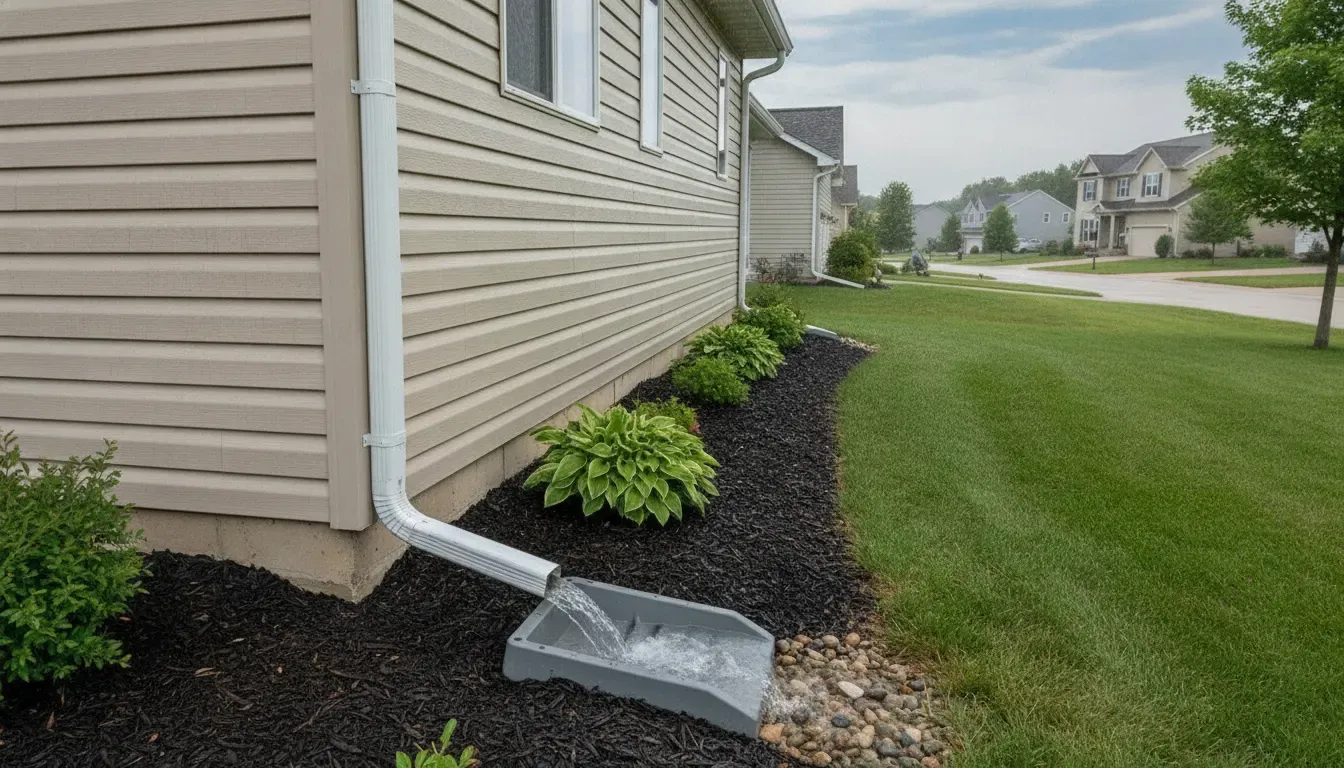
Downspouts should be placed where they can receive water from the gutter run without creating long, heavily loaded channels. They also need a clear route to an extension, splash block, underground drainage feature, or another approved discharge method. Discharging directly against the foundation defeats the purpose of the gutter. City of Duluth homeowner guidance recommends extensions that direct roof runoff away from the structure and notes that site grading should move water away from the foundation. Review Minnesota homeowner drainage guidance from the City of Duluth.
Roof valleys, dormers, inside corners, and low sections deserve extra attention because they can concentrate runoff. If water regularly spills over one area while the rest of the system remains clear, the issue may involve capacity, slope, an outlet location, or a roof drainage pattern rather than ordinary debris. See the detailed downspout placement guide for a closer look at drainage locations and discharge paths.
What Benefits Can Rain Gutters Provide?
Well-designed rain gutters help control where roof water goes. They do not make a home waterproof by themselves, but they reduce several common sources of exterior moisture when the channels, downspouts, and discharge points are kept open and correctly directed.
- Foundation protection: Moving roof runoff away from the home can reduce repeated saturation beside foundation walls.
- Less soil erosion: Controlled discharge helps limit channels and bare spots forming beneath roof edges.
- Fascia and soffit protection: Sound attachment and clear flow reduce the chance of persistent overflow at the roof edge.
- Siding and window protection: Directing runoff away from walls can help limit staining and repeated wetting around exterior openings.
- Better landscape control: Extensions and planned outlets can keep roof water from washing across planting beds, walkways, and entry areas.
- Easier maintenance: A properly laid-out system makes it simpler to identify where water should flow and where a blockage may be located.
The result depends on the whole path, from the roof edge to the final discharge point. Building America recommends directing water to sloping grade away from the foundation or using an appropriately designed underground drainage or collection system. Explore Referred Restoration’s gutter services in Rogers if you are unsure whether your current system is controlling runoff properly.
Contact Referred Restoration online for a free inspection of gutter channels, downspouts, and discharge paths. You can also call (763) 726-4245.
How Should Minnesota Homeowners Care for Gutters?
Gutter care starts with keeping the drainage path open and checking the system after weather that can move debris or loosen attachments. Look into the channels, inspect the downspout outlets, and watch where water lands during a normal rain. If water spills over a clear channel, the issue may be slope, capacity, attachment, or an obstruction farther down the path.
- Remove leaves, twigs, roof grit, and other debris from the channel and outlet.
- Flush downspouts with water when conditions are safe and check for slow or blocked flow.
- Look for sagging runs, separated seams, loose hangers, cracks, rust, and pulled-away sections.
- Check that extensions and splash blocks still direct water away from the foundation.
- Inspect around corners, valleys, fascia, and roof edges for stains or repeated overflow.
- Keep ladders on stable ground and avoid working on icy, wet, or steep surfaces.
- After major storms, check for impact damage and debris before the next heavy rain.
In Minnesota, spring cleanup should address debris and damage left by winter. Summer inspections should focus on storm runoff and fast-growing vegetation. Fall care should account for leaves and roof grit. Winter checks should be approached from the ground because ice and snow make ladder work especially hazardous. Use the Minnesota gutter maintenance calendar for a more detailed seasonal routine.
Gutter guards can reduce the amount of loose debris entering a channel, but they do not eliminate inspection. Guards need to fit the roof and gutter design, remain clear, and still allow water to reach the channel during heavy weather. Compare gutter guard options for a Minnesota home and learn what gutter guard installation involves.
Can Gutters Prevent Ice Dams?
Rain gutters can help carry meltwater away when the roof edge is clear, but they cannot prevent every ice dam. The University of Minnesota Extension explains that ice dams form when different parts of a snow-covered roof remain at different temperatures. Snow melts on a warmer upper roof surface, then refreezes at a colder roof edge and blocks drainage. Read the University of Minnesota Extension guide to ice dams.
A clogged or damaged gutter can make winter drainage worse, and ice can add weight to a weak or poorly attached channel. However, removing an ice dam usually requires a safe, condition-appropriate response, and preventing recurring dams often involves attic insulation, air sealing, and roof ventilation. Do not chip at ice from a ladder or use a method that could damage shingles, flashing, or the gutter system.
For a Minnesota home that has repeated winter overflow, review both the gutter system and the roof and attic conditions. Treating only the visible ice at the eave may leave the underlying heat-loss pattern unchanged.
When Do Gutters Need Repair or Replacement?
Repair may be appropriate when damage is isolated and the rest of the system remains straight, secure, and able to carry water. Replacement deserves consideration when multiple sections sag, cracks or rust are widespread, seams repeatedly leak, the channels have pulled away from the fascia, or the layout no longer handles the roof’s runoff. Repeated overflow after cleaning is another reason to inspect the full system.
Look for water stains beneath the roof edge, soil washout near downspouts, pooling beside the house, damp areas near the foundation, and visible damage to fascia or siding. These signs do not identify one guaranteed solution, but they show that the water path needs attention. Review the warning signs for gutter replacement in Minnesota before deciding whether a local repair or a new system is the better fit.
During an inspection, a professional can evaluate the roof drainage pattern, gutter profile, attachment points, downspouts, outlets, extensions, and surrounding grade together. That broader view helps avoid replacing a channel while leaving a blocked outlet, poor discharge route, or roof-edge issue unresolved.
How Can Rogers Homeowners Choose the Right Gutter Plan?
The right plan starts with the home rather than a one-size-fits-all product. A Rogers homeowner should consider the roof shape, the number of roof sections, tree exposure, snow and ice history, current overflow locations, exterior appearance, and the safest route for water after it leaves the downspout. A clear inspection can show whether the next step is maintenance, repair, or a custom replacement.
- Inspect the roof edge, channels, outlets, downspouts, and discharge areas.
- Match the profile, material, capacity, and attachment method to the home.
- Confirm that water will drain away from the foundation and surrounding structures.
Referred Restoration provides gutter inspection, repair, replacement, seamless gutter installation, and downspout services for Rogers-area homeowners. The company describes a simple process: schedule an inspection, review a custom solution, and move forward with professional installation when appropriate. Visit the Rogers gutter service page to learn more about the available service path.
Contact Referred Restoration online to request a free inspection and discuss rain gutters for your home. You can also call (763) 726-4245.
Frequently Asked Questions About Rain Gutters
What type of rain gutters are best for a Minnesota home?
The best choice depends on the roof drainage pattern, desired appearance, weather exposure, and maintenance needs. K-style or half-round profiles may both work, while aluminum, steel, copper, or vinyl each have different characteristics. A professional should match the complete system to the home.
How often should rain gutters be cleaned in Minnesota?
Cleaning frequency depends on tree cover, roof debris, gutter guards, and storm exposure. Many homeowners inspect in spring and after autumn leaf drop, then check again after major storms. A gutter that overflows while clear needs a broader inspection rather than repeated cleaning alone.
Do seamless gutters work better than sectional gutters?
Seamless gutters have fewer joints along straight runs, which can reduce potential leak locations. Sectional gutters can still work when they are correctly sized, joined, sloped, and secured. The installation details, corners, outlets, and downspouts matter as much as the channel type.
Where should a gutter downspout discharge?
A downspout should carry water to a stable discharge area that directs it away from the home’s foundation and does not create a problem for a neighboring property or walkway. The correct location depends on grade, soil, landscaping, and whether an underground drainage or collection system is present.
Can gutter guards replace gutter maintenance?
No. Gutter guards can reduce the debris entering a channel, but they still need inspection and may need cleaning. Leaves, roof grit, seeds, ice, and poor water flow can affect guarded systems. The guard must also be compatible with the gutter and roof edge.
What are signs that rain gutters are failing?
Common signs include sagging, pulled-away sections, cracks, rust, recurring leaks, overflow during ordinary rain, water stains below the roof edge, soil erosion, and pooling beside the foundation. A professional inspection can determine whether the issue calls for cleaning, repair, or replacement.
Contact Referred Restoration online for help evaluating rain gutters, downspouts, and water drainage at your Rogers-area home. You can also call (763) 726-4245.